|
Trip to Darfur - Travelogue
Introduction The Res Publica Team that runs Darfurgenocide.org recently returned from a six-week trip to Darfur and the surrounding areas. The trip was funded in part from money raised over this website.
 We went to Darfur to learn what Darfurians think is needed to bring lasting peace to their land and how the international community can support that goal. We found strong, popular, legitimate local groups, particularly the Sudan Liberation Movement/Army, who have fought to protect their people and now need the international community’s support to help win a meaningful settlement from the Government of Sudan at this summer’s peace talks. We have written a report summarizing our findings and advocating for greater engagement with Darfurian groups. We are currently lobbying both Governments and activists with our conclusions. Download the report here. We went to Darfur to learn what Darfurians think is needed to bring lasting peace to their land and how the international community can support that goal. We found strong, popular, legitimate local groups, particularly the Sudan Liberation Movement/Army, who have fought to protect their people and now need the international community’s support to help win a meaningful settlement from the Government of Sudan at this summer’s peace talks. We have written a report summarizing our findings and advocating for greater engagement with Darfurian groups. We are currently lobbying both Governments and activists with our conclusions. Download the report here.
Donate to our Advocacy Fund and help us secure justice for the people of Darfur
We hope the travelogue on these pages helps you to experience some of the people, places and issues we encountered in Darfur. Please use the menu below to navigate through the different sections, which include lots of photographs and personal stories as well as analysis and advocacy points.
Contents
(Please click on a heading)
♦ Introduction
♦ Context and Purpose of Trip
♦ Traveling in Darfur - Life Continuing Amidst the Scars of War
♦ Fatima's Story - A Window onto the Tragedy
♦ Getting to Know the Sudan Liberation Army
♦ Eritrea, Ethiopia, Chad - Meeting Political Leaders, African Union Staff and the Conflict in the East
♦ The Justice and Equality Movement
♦ Key Conclusions - Messages for Activists and the International Community
♦ General Map of Darfur - More Detailed Maps of Darfur, including Towns and Refugee Camps
Context and Purpose of Trip
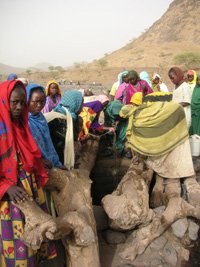
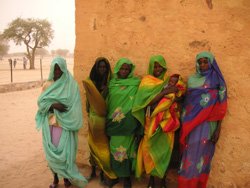
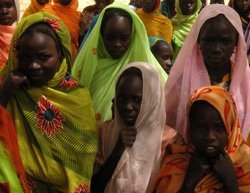
Women at a well in Dirbat, Darfur
|
In the past few months, a fragile peace has fallen on Darfur with a decline in fighting and killing. Policy makers and activists alike have been deciding how best to proceed to support a lasting peace that will prevent a return to slaughter. Darfurians and their representatives will be key players in any peace process, yet there has been minimal engagement with these groups and little detailed information is available about them or what they want.
Our primary mission was to meet with Darfurian groups – tribal leaders, religious sheiks, citizen groups, and armed resistance movements – to identify which ones had support from the people and what strategies Governments and people of conscience in the West could employ to support their efforts to bring a lasting peace to their land. Few analysts or journalists had spent time with these leaders on the ground since the conflict escalated and we hoped our trip would shed some light on who these groups are, what they stand for, and whether and how they can be serious partners for peace and justice in Sudan.
Back to Contents
Traveling in Darfur - Life Continuing Amidst the Scars of War
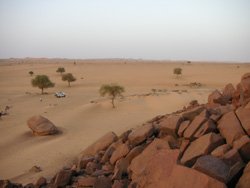
Entering Sudan – Destroyed Villages We crossed from Chad into Sudan and the rebel-held or “liberated” territory in Northern Darfur. Darfur is an enormous region, roughly the size of France or Texas. Most of it is desert or semi-arid brush.
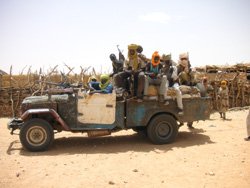
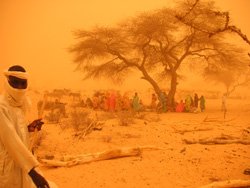
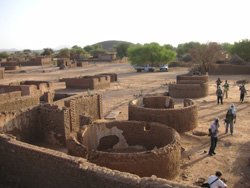
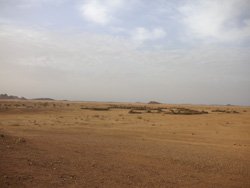
For the first couple of hours, the landscape was barren, punctuated occasionally by abandoned villages. Some of them were destroyed and empty, in others a few families had managed to stay eking out a living from the dry land. Because many homes in Darfur are made of straw and were burnt, a lot of the destroyed villages look like open desert scared with fire – you just have to imagine that a village once stood there like in the picture below (right). Where homes had a brick base, the stumps of houses remain like in this picture below (left) of the thrice-destroyed town of Korma.
We reached the Sudan Liberation Army (SLA) base in Furawiya late at night and were met at the outskirts by a dozen rebels with rifles at the ready. Once they had verified that their commanders had given us clearance to travel, the rifles disappeared.
Though the area is heavily populated by the Zagawa tribe, we met dozens of soldiers and commanders from a variety of tribes serving side-by-side.
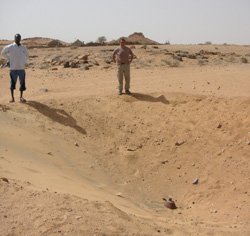
Walking through the town we saw damage from the various aerial attacks by the government, including a bomb crater and unexploded bomb in the town center.
From Furawiya to Muzbat – Hospitality and a Vibrant Life despite Humanitarian Crisis Tribes in Darfur honor guests, and the SLA provided us with a two-car convoy to Muzbat, their headquarters for North Darfur. We enjoyed this kind of humbling, generous hospitality wherever we went and whichever tribe our host came from. Families regularly slaughtered precious animals to feast in our honor. We soon realized that it was more important to them to treat us honorably than to save the food, however uncomfortable we were with their sacrifice.
Throughout our trip we were carrying thousands of dollars in cash and expensive camera equipment but realized within a week that we did not need to keep an eye on our stuff. Neither the destruction of their communities nor the loss of loved ones nor the suffering at the hands of tyrants had damaged Darfurians’ sense of honor or virtue.
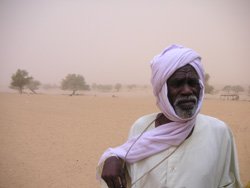 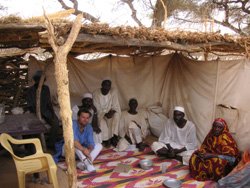
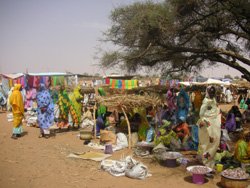
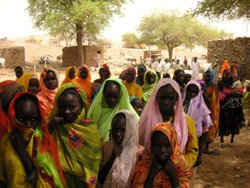
As we traveled through liberated territory, we found many people carrying on their normal, busy routines – traders going to markets, children to schools, and community organizations functioning to various degrees. We heard from all sides how tough life had become. But people remained resilient, volunteering and otherwise contributing to keep their communities going, including running schools that manage to operate without budgets.
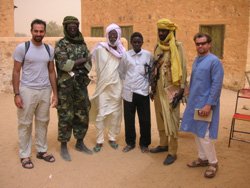
Muzbat is a major town with hundreds of SLA troops, over 10,000 people and scores of livestock. When we arrived, we were met by Sulaiman Gamos, the Humanitarian Coordinator and a senior statesman for the SLA, Commander Jido, the third -in-command of the armed forces, and Sala Bob, the Chief of Intelligence and a founding member of SLA (see picture right).
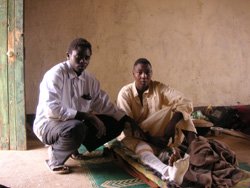
In Muzbat we stayed in the hospital, and were able to speak extensively with Dr. Mohammed, who is in charge of medicine for the SLA and rebel-held territories. A friendly and intelligent young man, he had just graduated from Medical School when the war in Darfur started. He bravely traveled home and single-handedly treated thousands of wounded Darfurians with almost no medical supplies or support. He told us that the humanitarian situation has improved considerably from a year ago, but that death rates – particular infant and maternal mortality rates – remain 3-4 times higher than before the war.
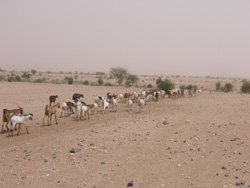
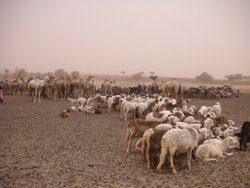
"Peace with no Animals..." Families in Darfur have built up herds of cattle, camels, goats, and sheep over dozens of generations. In a desolate landscape, these animals are all that the people have to survive. A single cow is worth more than $1000. The Janjaweed have stolen or killed tens of thousands of head of livestock in Darfur, destroying the lifestyles and livelihoods of thousands of families and villages. We asked one 8 year-old boy if he had hope for peace in Darfur. He said, “Maybe. But peace with no animals.”
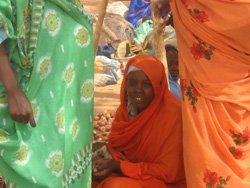
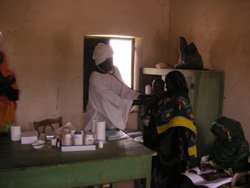
Dirbat and Women’s Views From Muzbat we traveled to the town of Dirbat where we met with the two women who chair the local Women’s Council to hear about conditions in the area and attitudes towards the SLA. They described the SLA as “our sons, our husbands, our protectors,” and said that they wanted peace but would support a return to fighting if the Government of Sudan refused to offer meaningful power and resource sharing with the people of Darfur. They also expressed, in contrast to many of the soldiers with whom we met, that they did not want to see Arabs reintegrated into their communities after the peace.
Back to Contents
Fatima's Story - A Window onto the Tragedy
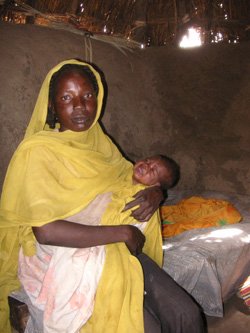
In Dirbat we met Fatima. She had been working at home when the Janjaweed attacked her town of Korma and went through the market killing hundreds of people. Her husband was one of those killed, and her eldest son, then 10 years old, watched his father die. Fatima fled the fighting with her children and crossed a huge and dangerous distance to come to the mountains, where the SLA would protect her. She had no money, she knew no one, and she had 4 children to support.
She speaks of the people of her new town with great gratitude. While they are also in total poverty, they have given her family a small hut and enough food to survive. But tragedy continues to follow Fatima’s family. Her son, who watched his father die, no longer speaks or smiles and she is afraid that he is mentally ill. She has no money to take him to a doctor. And then, just last week, Fatima’s eldest, 12 year old, daughter fell down a well and died. She shows us the blood stained dress of her daughter and despairs.
Before leaving Dirbat, we made a donation from Darfurgenocide.org members to Fatima's family and her village to provide for food and medical supplies
Back to Contents
Getting to Know the Sudan Liberation Army (SLA)
The Sudan Liberation Army (SLA) is the main resistance movement in Darfur. They are teachers, farmers, herdsmen and students from all the many tribes of Darfur who took up arms to protect their communities from the Government and Janjaweed oppression and attacks. They have saved thousands of lives and now control vast areas of Darfur providing safe havens for civilians. They are an entirely voluntary force numbering well over 10,000. Throughout our journey we had the opportunity to meet many of their top commanders and political leaders as well as spend time with the rank and file members and watch how the group interacted with and were viewed by civilians.
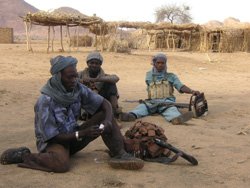 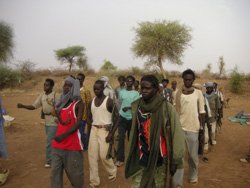
The Fighters Most of the soldiers we met had been teachers, farmers, herders, or students until their families came under attack two years ago. We found that they were dedicated to protecting their communities and winning a just peace that will give them the political representation and development that they believe will prevent the atrocities from ever recurring. The camps we visited were surprisingly free of the machisimo of many rebel groups – no random firing of weapons, internal squabbles or flexing of muscles. When asked what they wanted after the war, almost all said they just wanted to return to their earlier life.
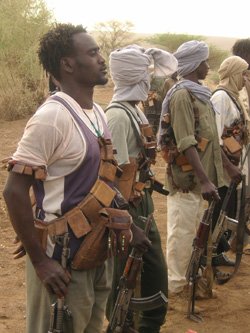 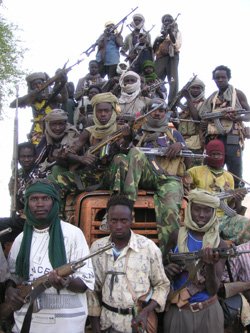
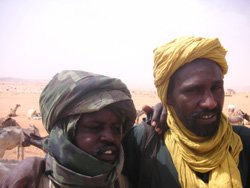
Comradeship Across Ethnic Divides The SLA is remarkably multi-ethnic at the commander and soldier levels. We met with Zagawa, Fur, Masalit, Tunjur, Dojo, and even Arab commanders many of whom knew each other and greeted each other as “brothers in arms” as we passed through different zones. In keeping with Darfurian custom, each meeting often involved several minutes of blessings and hellos. Pictured here are SalaBob (right) - one of the most popular SLA commanders and a founder of the group - and a Commander from the Tunjur tribe. SalaBob is a Zagawa but enjoys deep respect and many contacts among the Fur.
Focus on Two Commanders – Sulaiman Gamos and Sala Bob Sulaiman Gamos (below left) is one of the oldest of the SLA leaders and acts as its humanitarian coordinator and general liaison to the international community. He is well-known and respected among civilians and commanders, though a few raised concerns about his former role inside the government. In the days before we arrived, he and Commander Sala Bob (below right) had organized a meeting of commanders from across Darfur to begin a process aimed at solving the leadership tensions within the movement. Their process of focusing on building consensus among commanders appears to be making more headway than any of the other myriad proposals we saw present among the “political” wing of the movement.
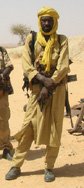
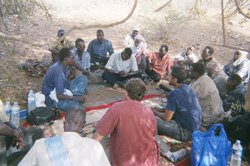
Egalitarian, Deliberative Culture We were surprised by the egalitarian ethos of the SLA, with commanders sleeping under the same trees and eating from the same platter as their men. Even decisions appeared to be reached deliberatively. This same egalitarian, deliberative culture was present among the commanders themselves who coordinated through a combination of heavy delegation to the local commanders and consensus on those matters that had to be decided collectively.
Visiting the SLA Base at Jebel Mara The SLA was born in Jebel Marra, a mountainous area at the nexus of North, South and West Darfur. On our visit there, we met up with Commander Torrada – one of the original and most well-known commanders – and his mobile camp of several hundred fighters. We were once again struck by the level of respect and equality between commanders and their soldiers, as they slept under the same trees, drank from the same wells, and generally deliberated together when decisions were made. Respected for many victories in battle, Torrada nonetheless is full of jokes and stories that kept everyone, including us, amused. The next day, we were allowed to watch one of the battalions as it conducted morning exercises.
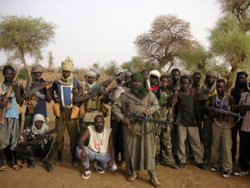
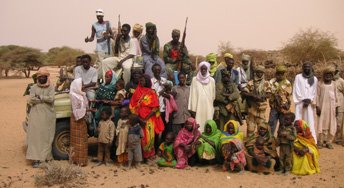
Civilians and the SLA The SLA is clearly a people’s movement. As we traveled through the “liberated” areas of Darfur, civilians – particularly women and children – would come out of their homes to cheer for the SLA as we passed through.
We were also struck by how comfortable the civilians in the “liberated” areas of Darfur felt walking through the SLA camps, including young women on their way to school or the make-shift markets. We interviewed village elders and women about conditions in the area, and all said that the SLA was providing security and described them as “our sons, our husbands, our protectors.”
Women and the SLA We interviewed individual women and the leaders of local Women’s Councils, and found that women felt secure from sexual violence when they were in rebel territories. They said there is no record of the SLA abusing women, and we watched 16 year-old girls walking comfortably through and around SLA camps en route to school or wells. This is in stark contrast to the widespread reports of Janjaweed militia raping women.
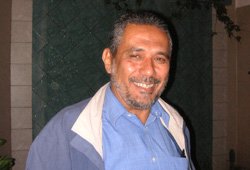
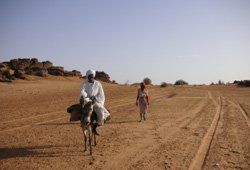
What Does the SLA Want? They want full citizenship for the people of Darfur in the form of full representation in the central government, resource sharing and development for their region. They are not a separatist movement nor are they interested only in Darfur’s problems. They support the notion of a “New Sudan” that is shared by oppressed peoples in Eastern and Southern Sudan as well. This vision, promoted by many including Dr. Taisier Ali (pictured below left), is to end decades of internal fighting with a common commitment to a democratic, federalist and secular state.
Back to Contents
Eritrea, Ethiopia, Chad - Meeting Political Leaders, African Union Staff and the Conflict in the East
Eritrea Our trip to get to know the groups in Darfur began in Eritrea, the unofficial political headquarters of the Sudan Liberation Army (SLA), the Justice and Equality Movement (JEM), and other Sudanese opposition leaders who have fled persecution in Sudan. Each group was politically fractured and we made sure to meet with representatives from the various factions. All sides agreed that the real center of power in these movements lies with the commanders on the ground in Sudan, who are the most important voices on issues of leadership and military strategy.
With world attention focused on Darfur, the Sudanese Government has escalated its abuses against tribes in the east, including the Rashaida and the Beja. The security situation is tense and experts fear another civil war may erupt soon. The resistance movements in the region have united into the “Eastern Front,” and we met with their leaders to assess their goals, tactics, and attitudes towards the situation in Darfur and the South, and to hear specific complaints about abuses by the Government.
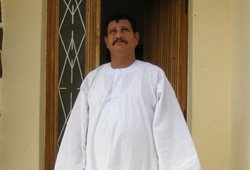
An early optimistic note on our trip was struck by the convergence of most opposition leaders around a vision they call the “New Sudan.” Rejecting decades of the Government exacerbating tribal, ethnic, regional, and religious divisions in Sudan, these groups are calling for a unified, multi-ethnic, secular, and democratic Sudan that guarantees equal rights to all and the devolution of power to the regional level. Dr. Taisier Ali (pictured here), a former professor at the University of Khartoum and advisor to many of the opposition groups, is one of the most vocal proponents of this vision.
Ethiopia and the Afrian Union En route to Chad, we stopped in Addis Ababa to meet with the African Union, which is mediating the Darfur peace talks in Abuja, Nigeria. Regional heads of state had just finished a summit in Libya declaring an accelerated timetable for resuming talks, but the unofficial word from a key AU official was that this timetable, while politically expedient, would undermine the talks. He believed the rebel groups should have the support and time to resolve their internal disputes before conducting serious negotiations.
Chad and Darfurian Refugees We met with SLA and JEM political leaders and some commanders in the Chadian capital of N’djamena, as well as senior officials at the UNHCR and the US Embassy. As in Eritrea, we found significant political divisions within the movements but absolute consensus that the Government of Sudan was the primary threat to peace in Darfur, and that a peace agreement that included power and wealth sharing was the only answer.
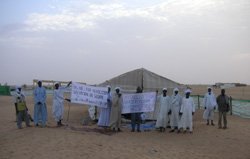
UNHCR officials and our own experience in the refugee camps of Eastern Chad revealed near universal support for the SLA among Darfurians. Most of the refugees had little knowledge of or position on the political divisions within the movements, but all felt like the SLA were the only group they trusted to protect them from atrocities. Distrust of the African Union, Government of Chad, UNHCR and others ran high. Some of the refugees brought out banners from a recent rally at the camp held in support of the various resolutions passed by the UN Security Council in May, including the decision to prosecute the architects of the atrocities through the International Criminal Court.
Back to Contents
The Justice and Equality Movement
There is a second resistance movement in Darfur called the Justice and Equality Movement (JEM) that consists largely of a sub-set of the Zagawah tribe known as the Kobay. From our observations, they have fewer than 1,000 troops on the ground and have retreated into a small area near the Chadian border. While they lack support on the ground, their leaders tend to be better educated, more politically sophisticated, and better funded than the SLA.
Back to Contents
Key Conclusions – Lessons for Activists and the International Community
- The people of Darfur are no longer fighting to stop the immediate violence. Their goal now is to ensure that the Government can never again oppress them or attack them. A “New Sudan” - one which is secular, democratic and gives all its people, including the Darfurians, a fair share of power and resources - is the only thing they believe can bring them this kind of justice and long-term peace. And they will fight for it at the negotiating table this summer.
- Darfurians clearly blame the Government of Sudan and not the Janjaweed for the war and the atrocities. They see a conscious, strategic, region-wide assault by the Government with the Janjaweed as mere pawns – even victims in the words of some.
- Darfurians deeply distrust regional and international actors, including the African Union and the UNHCR, as too easily manipulated by Khartoum or simply ineffective. Most of all, they have no faith in the Government of Sudan to negotiate in good faith or maintain any promises not to repeat its abuses.
- The Sudan Liberation Army is clearly seen by the people as “their” movement, and we did not hear of a single instance of civilian abuse. The SLA is a multi-tribal force dedicated to a democratic, secular Sudan that provides representation and equal citizenship to all regions of the country.
- While the SLA has a stronger military presence and better civilian relations than we expected, their political leadership is weak and fractured
- The prosecutions by the International Criminal Court are seen as one of the most hopeful and definitive steps against those most responsible for the suffering in Darfur. But people in Darfur have dangerously unrealistic expectations of how quickly this can proceed. The international community, including the ICC and activist groups, must do everything in their power to accelerate this process or risk a backlash of disappointment and loss of credibility.
Back to Contents
"Darfur Genocide, Sudan Genocide, Action, Information"
|